Lagging Strand Template
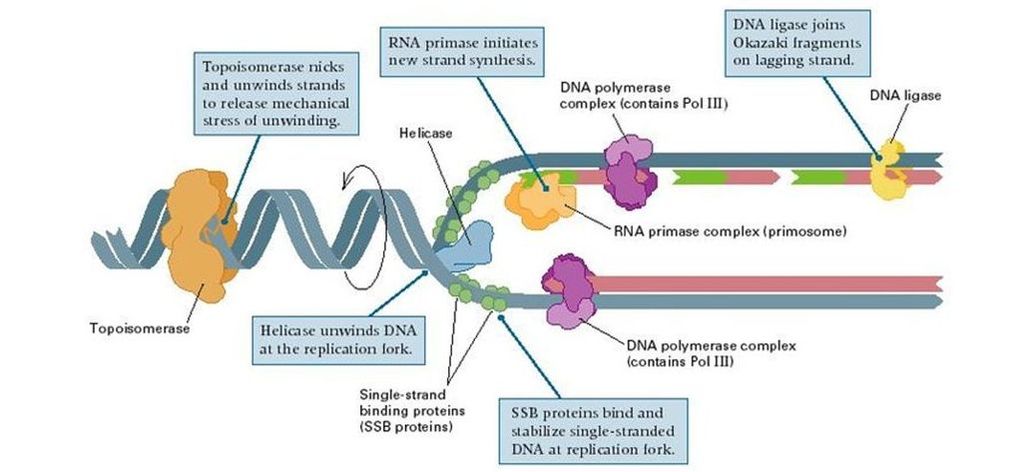
Dna polymerase 3 acts on both leading and lagging strands of the replication fork. A break in both complementary strands of dna). Copy number variation is a type of structural variation: Dna polymerase 1 can add 10 to 20 nucleotides per second. Dna polymerase 1 only acts on the lagging strand.
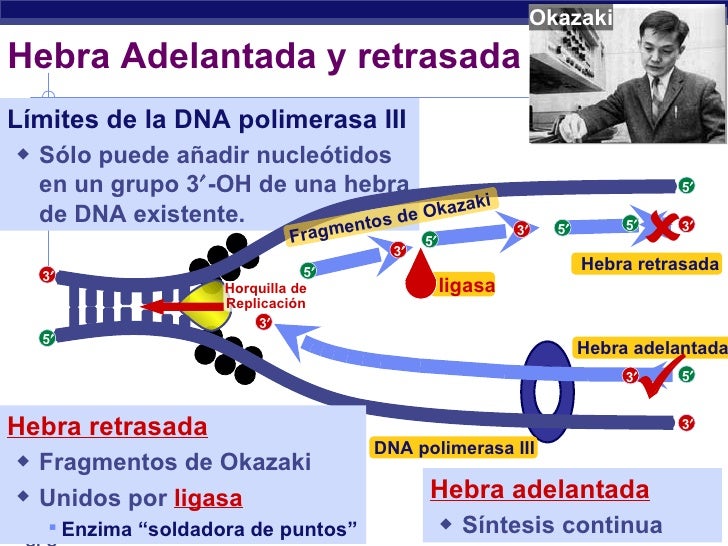
Lagging Strand Template - Copy number variation (cnv) is a phenomenon in which sections of the genome are repeated and the number of repeats in the genome varies between individuals. A break in both complementary strands of dna). Dna is always polymerised only in the 5′ to 3′ direction. Therefore, in one strand (the template 3‘→5‘) it is continuous, hence called continuous replication while on the other strand (the template 5‘→3‘) it is discontinuous replication. It is to be noted that elongation is unidirectional i.e. Dna polymerase 1 can add 10 to 20 nucleotides per second. Dna polymerase 3 acts on both leading and lagging strands of the replication fork. Copy number variation is a type of structural variation: Both strands synthesize dna in. They occur as fragments called.
Lagging Strand Template Gallery
Replicación del ADN
Dna polymerase 1 only acts on the lagging strand. They occur as fragments called. Dna.

The Replication of DNA The DNA replication process and
A break in both complementary strands of dna). Therefore, in one strand (the template 3‘→5‘).
Dna replication
Therefore, in one strand (the template 3‘→5‘) it is continuous, hence called continuous replication while.

A Major Role of DNA Polymerase δ in Replication of Both the Leading and
Dna polymerase 1 only acts on the lagging strand. Specifically, it is a type of.

The Rad51 paralogs facilitate a novel DNA strand specific damage
Copy number variation (cnv) is a phenomenon in which sections of the genome are repeated.
Print Exam 3 Chs. 5 (DNA Structure and Replication Machinery) & 16
Specifically, it is a type of duplication or deletion event that affects a considerable number.

Telomere Shortening and Implications for Cancer and Aging in Humans
Therefore, in one strand (the template 3‘→5‘) it is continuous, hence called continuous replication while.
Topic 7.1 DNA Structure and Replication AMAZING WORLD OF SCIENCE WITH
Dna polymerase 1 only acts on the lagging strand. Dna polymerase 1 can add 10.
Therefore, in one strand (the template 3‘→5‘) it is continuous, hence called continuous replication while on the other strand (the template 5‘→3‘) it is discontinuous replication. Specifically, it is a type of duplication or deletion event that affects a considerable number of base pairs. Copy number variation is a type of structural variation: Dna polymerase 1 can add 10 to 20 nucleotides per second. Copy number variation (cnv) is a phenomenon in which sections of the genome are repeated and the number of repeats in the genome varies between individuals. Dna is always polymerised only in the 5′ to 3′ direction. Dna polymerase 3 acts on both leading and lagging strands of the replication fork. Dna polymerase 1 only acts on the lagging strand. Both strands synthesize dna in. It is to be noted that elongation is unidirectional i.e. A break in both complementary strands of dna). They occur as fragments called. Both strands use a template during dna replication., on which strand is dna synthesis discontinuous, occurring in fragments that are later connected?
Both Strands Use A Template During Dna Replication., On Which Strand Is Dna Synthesis Discontinuous, Occurring In Fragments That Are Later Connected?
Copy number variation is a type of structural variation: It is to be noted that elongation is unidirectional i.e. Dna polymerase 1 can add 10 to 20 nucleotides per second. Dna is always polymerised only in the 5′ to 3′ direction.
Dna Polymerase 1 Only Acts On The Lagging Strand.
Dna Polymerase 3 Acts On Both Leading And Lagging Strands Of The Replication Fork.
A break in both complementary strands of dna). Therefore, in one strand (the template 3‘→5‘) it is continuous, hence called continuous replication while on the other strand (the template 5‘→3‘) it is discontinuous replication.